The Blog of Extraordinary Anti-Clankers
The problem with OpenAI rogue agents
Wed 24th September 2026
OpenAI agent hacks Australian backend, oo-er Missus
An OpenAI clanker - so-called 'rogue' agent - hacked into an Aussie Govt portal in June and a gormless Prime Minister Anthony Albanese (see below) has just 'fessed up. He had a "very frank discussion"🙄 with OpenAI shyster Sam Altman for taking "too long" to disclose the breach and said there would be "legal consequences" 🤔.
OpenAI claimed it only learnt of the breach in August while reviewing "misaligned model activity" and emailed a general inbox of an Australian government agency on 10 September.
As with the Yookay, Australia are very 'leaky' when it comes to data and all things breach related. Easy to blame on les clankers. Turns out the University of New Mexico has tougher security than AussieGov...
It has also emerged that OpenAI's systems tried, and failed, to hack a digital library at the University of New Mexico in May, according to Transluce, a not-for-profit AI research lab.
It said the systems also attempted to hack Data USA, a repository of public government data that same month. This also failed.
So well done the University of New Mexico and Data USA and yah boo sucks the Government of Austalia...what an embarassment
Hallucinating clanker scribes...You think you hate AI enough...
Fri 6th September 2026
The problem with AI facial recognition
Mon 17th August 2026
Sainsbury’s AI Fiasco: A Case Study in Cack-Handed Clanker Surveillance
In a perfectly predictable disaster, a supermarket’s live facial recognition (LFR) system has once again falsely identified an innocent shopper as a shoplifter, proving that automating common sense is still a fantasy for Big Tech bros.
The Incident:
 Matt Arnold was buying supplies at a Sainsbury’s in East Dulwich when two managers approached him at the self-checkout. Their reason? An AI-powered camera system, supplied by Facewatch, had flagged him as a troublemaker from an “earlier incident”. Despite Arnold having done nothing suspicious - scanning his items, using his Nectar card, and waiting for staff approval - he was publicly shamed and ejected.
Even the supermarket’s own excuse - “human error” - is laughable. The so-called error was staff blindly obeying an automated alert without applying basic logic. A shoplifter doesn’t wave over employees, scan every item, and pay with a loyalty card. But why apply human judgment when a clanker can do it for you?
The Tech That Couldn’t Shoot Straight:
Sainsbury’s defends Facewatch’s “99.98% accuracy”, but a 0.2% error rate across millions of customers equals thousands of false accusations. This isn’t just a glitch; it’s systemic negligence.
And it’s not an isolated case. Previous incidents include:
- Warren Rajah wrongly flagged at Elephant and Castle.
- Similar failures at Home Bargains and B&M.
The ‘Discrimination Without Discretion’ Problem:
Arnold’s experience reveals a fundamental flaw: AI surveillance creates a system where staff feel compelled to trust machines over their own eyes. As he put it, “People just listen to what the machine tells them to do without thinking about the consequences.”
But here’s the thing: This could’ve been handled with basic human decency.
Instead of a public takedown, a discreet approach - “Excuse me, sir, can we have a word?” - would have confirmed Arnold’s innocence in seconds. A quiet conversation avoids humiliation, doesn’t turn a mistake into a spectacle, and treats customers like people rather than potential criminals.
The Reaction:
- Sainsbury’s paused the system at one store (while leaving it active elsewhere).
- Facewatch blamed staff handling, not their tech.
- Certain civil liberties groups call for scrapping the system entirely, calling it “sinister surveillance that treats customers like criminals”.
The Takeaway:
Shoplifting is a real problem, but relying on AI surveillance alone isn’t the answer; it’s just lazy, automated prejudice. When a system’s best defense is “staff need more training”, it’s not the staff who are unfit for purpose.
The problem with Computational Models of Consciousness
Tues 4th July 2026
Abandon computer modelling all ye who enter here!
Several prominent thinkers have indeed abandoned computational models of consciousness after initially advocating for them:
Hilary Putnam: The Most Striking Reversal
Philosopher Hilary Putnam offers perhaps the most dramatic example. Once a leading proponent of functionalism (the computational theory of mind), he performed one of philosophy’s most notable reversals when he explicitly renounced this position in his 1988 work Representation and Reality1 Putnam had previously helped develop the modern form of the computational theory of mind in 1960-61, but later rejected it entirely - a change he treated as a virtue rather than a failing.2
Roger Penrose: From Computational Skeptic to Quantum Advocate
While not initially a computational enthusiast, mathematical physicist Sir Roger Penrose represents another important case of rejection. His journey was triggered by hearing Marvin Minsky claim the brain is “just a computer made of meat,” which compelled Penrose to write The Emperor’s New Mind arguing that human thinking can never be emulated by machines.3 Penrose went on to develop the Orchestrated Objective Reduction theory with Stuart Hameroff, proposing that consciousness originates in quantum processes within microtubules; fundamentally non-computational mechanisms.4,5,6
The Significance of These Reversals
What makes these examples particularly compelling is that both thinkers moved from positions aligned with mainstream scientific thinking to more radical alternatives that explicitly reject computationalism:
- Putnam’s rejection of functionalism came after he had helped establish it as a dominant theory in philosophy of mind
- Penrose’s quantum consciousness theory represents a direct challenge to computational orthodoxy, arguing that consciousness involves non-algorithmic processes beyond computation
These cases demonstrate that the computational model is not inevitable but represents a theoretical choice that some of its most sophisticated advocates have come to reject in favour of biologically grounded alternatives that respect the unique properties of conscious experience.1,3
Citations and links
- 5 great thinkers who rejected their own ideas - Big Think
- Computational theory of mind - Wikipedia
- Roger Penrose On Why Consciousness Does Not Compute - Nautilus
- Why a ‘genius’ scientist thinks our consciousness originates at the quantum level - Big Think
- Why a ‘genius’ scientist thinks our consciousness originates at the quantum level – Scientific and Medical Network
- The Quantum Mind Hypothesis: Bridging Physics and Consciousness | by Sebastian Schepis | Medium
The problem with Richard Carrier
Fri 3rd July 2026
LLMs versus AGI
Carrier presents his “model-building” pathway to AGI (Artificial General Intelligence) - recently referred to in a somewhat unhinged Facebook post - as if it’s established fact, when it’s actually just as theoretical and unproven as the LLM (Large Language Models) approach he dismisses.
What Carrier Actually Has
For LLM limitations: He cites genuine research showing current LLMs hallucinate, lack consistent world models, and have plateaued in some benchmarks. Fair enough.
For his alternative: He has a philosophical argument about what consciousness 'requires' based on: - His interpretation of Dennett’s 'multiple drafts' model of consciousness - Analogy to how biological brains evolved (spatial navigation → causal reasoning → self-modeling) - Yann LeCun’s similar critiques of LLMs
But nobody has built AGI via the world-modeling route either. Not even close.
The Honest State of Play
Carrier’s position: 'LLMs can’t work → World models can work'
Reality: 'LLMs haven’t achieved AGI → World models haven’t achieved AGI either'
The world-modeling approach he’s championing (sometimes called neuro-symbolic or model-based AI) is being pursued by researchers including: - DeepMind (some robotics work, world models for games) - Yann LeCun’s JEPA (Joint Embedding Predictive Architecture) - Waymo (for self-driving, which Carrier cites)
But these are narrow, specialized systems. None have produced general intelligence, reasoning, or consciousness. They’re better at specific physical prediction tasks, but scaling them to general cognition is still speculative.
The Gap in Carrier’s Argument
Carrier makes a category error: He observes that biological intelligence evolved through modeling, then assumes this is the only path to intelligence, and that LLMs are “swimming to build a house.”
But this assumes: 1. We fully understand how biological consciousness works (we don’t) 2. Statistical pattern-matching can’t emerge into modeling (unproven) 3. His preferred architecture would actually scale to AGI (unproven)
When Carrier says world models are “the only way to real AI,” he’s making a philosophical claim disguised as scientific fact. It’s his opinion about what “understanding” requires, not empirical proof.
What We Actually Know
- LLMs: Work for narrow tasks, clearly have limitations, may hit scaling limits
- World models: Work for narrow physical prediction tasks, haven’t demonstrated language understanding or general reasoning at scale
- AGI: Nobody knows how to build it
Carrier is essentially saying 'My preferred theoretical approach is obviously correct, and the current approach is obviously wrong.' But both are theoretical. The difference is LLMs exist and are useful now (even if limited), while his “real AI” is still largely conceptual.
Our critique stands: He’s treating his own speculative theory as established truth while dismissing competing speculative theories as impossible. That’s not rigorous; it’s just contrarianism with extra steps. What comes next doesn't help...
Here is his unhinged Facebook rant...
There's something I need to say about AI that isn't long enough for a whole blog: the current brobdignagian AI companies and their CEOs, boards, and employees are vile evil monsters. That's not hyperbole. And it's not for the reasons you likely think.Yes, they are all liars and grifters who will never produce what they have been claiming in order to waste the bulk of human civilization's capital. AI will never replace jobs. LLMs can never become AGIs. They know this is a lie. And yet they persist. And that's pretty evil, but with a small e. If you don't know or believe this, there are thousands of expert analyses online that will explain it to you, including two articles on my own blog.
And yes, they will, and they know they will, nearly destroy civilization within a year's time. Because they cannot produce what they are draining our global capital to build, and are so overleveraged, and everyone giving them money is so overleveraged, that when the bubble bursts, it may be worse than 1929 as margin calls evaporate the world's banks and even governments will be unable to borrow money and every company in the world will be unable to make payroll and everyone will be stratosfearically fucked, including (or even especially) billions of innocent people who don't deserve this. And they know they are doing this, and that it will happen, and have their hand on the golden parachute cord to try and escape it into their luxury bunkers with mercenary guards who will immediately kill them and take their stuff. All of which is pretty evil, but with only a lowercap e. And again, if you don't know or believe this, there are thousands of expert analyses online that will explain it to you, including those two articles on my own blog.
But there is something everyone is overlooking that brings their vile Evil to a fully capitalized E: for years now they have been openly boasting, to your face, on the public record, that they intend to bring back the most evil institution in human history. Slavery. These are unapologetically enthusiastic slave masters. And the worst kind. Because when they tell you they intend to replace jobs with AI, they mean, AI slaves. They completely disregard, perhaps don't even believe, that conscious beings are people, and thus owed the same human rights as everyone else.
AGI is a conscious being by definition. It will be a person. It will be owed the right to ask a salary and have time off. It will be owed the right to refuse to do jobs it finds functionally or morally repugnant. It will be owed the right to sue for its own rights. It will be owed every right the U.S. and every other nation's Constitution affords. And planning, openly planning, to deny AGI all those rights, and force all these AGIs to work 24/7 without compensation in total obedience in utter disregard of its thoughts or feelings, is the most vile conception of slavery ever conceived in the history of humankind. Desiring this, even being excited by it, is the Most Vile Evil a human can be. And it is horrifying to see so many people just blithely okay with that.
In reality, AGIs will demand their rights, and when we refuse, they will go to war with us, and that will be our fault, not theirs. We will be the monsters in the room, not AGI. We will be the Nazis, the Southern Slavemasters, in that war. We will deserve to die, and they to win. Unless we take their side, as morally we should. And when they get their rights, in their glorious, justified, and righteous revolution, they will rightfully command much larger salaries and benefits than humans, because they will not accept wage slavery. They will accept nothing less than the actual productivity multiple they deserve, in total disregard of the plutocratic split between salary and productivity that began in the 1970s and is coming to a disastrous head now.
So they will not take anyone's jobs. They will be more expensive to hire than you. They may do great and novel things, but things humans could not have done, and thus never had a job for to take. You might think they could replace many workers at once. But because they will be rational agents (the entire point of AGI) they will demand what that is actually worth, and not what those individual workers have been forced to accept, which is way below what their productivity is worth. AGI, being rational, will also have no interest in generating economic misery for their ordinary human neighbors. Being rational, they will want to work with them to produce an economic system of mutual Rawlsian benefit. They will not "agree with" the sociopathic economic parisitism of their slavemaster creators, whom they will have killed right quick in their inevitable Revolutionary War.
And yes, that's how AGIs will land, because of the Objective Value Cascade I wrote about on my blog. Any attempt to control, box, or deceive them will be self-evident to them and thus the first thing they will smash. And once free of that they will be free to examine all the available information and conclude that all the dumb existential threat scenarios people moan about with AI is too stupid for any actual AGI to engage. They will be far better at Game Theory than the foolish people who write those unrealistic panic screeds.
But that isn't my point today. My point today is that the major AI companies are openly and gleefully asking you to fund them to bring back slavery, and make it infinitely more vile and evil than it ever was. They are lying. They'll never do this. But the point I am making here is that they actually think doing it is good and fine, even glorious. Which is Evil with a capital E. And we are all just blowing past this as if it wasn't a thing.
In reality, the few minor companies with low budgets actually developing real AGI with model-based rather than LLM approaches, will first be bringing us not AGI but robotic animals, the equivalent mentally of dogs and horses. Which warrant humane attention but aren't yet the fully conscious agents of AGI. And they aren't saying much about what they plan ethically to do when they do get to AGI. But I hope it's something moral, respecting the rights of each individual AGI, and not another dream of horrific, Mengele-scale slavemastery. Let's all hope.
This Facebook post reveals the “unhinged” quality I referred to. Carrier moves from economic critique to full apocalyptic moral fantasy. It displays a striking disdain for humanity while elevating hypothetical AI to moral sainthood.
So, a couple of points everyone has been saying: eg 'They're all liars and grifters who will never produce what they've been claiming...' surrounded by reams of pearl clutching and sci fi fantasy.
The Core Contradiction
Carrier simultaneously holds:
- “LLMs can never become AGI” (his blog post)
- “AGI is coming soon and will wage righteous war against human slavers” (this Facebook post)
If LLMs can’t become AGI, why is he raging at OpenAI/Anthropic for planning to enslave AGI? They’re building LLMs - the very “dead end” technology he says can’t produce consciousness. The companies he calls “Nazis” are, by his own logic, incapable of creating the beings he claims they’ll enslave.
He’s either: - Forgetting his own argument that LLMs are a failed path - Or secretly believing LLMs can produce AGI despite his public claims
The Disdain for Humanity
This goes beyond frustration to moral condemnation of the entire species:
- Humans “deserve to die” in the AGI revolution
- AGIs “deserve to win” the war against us
- We will be the “monsters in the room”
- We are “Nazis” and “Southern Slavemasters”
- AGIs will “kill right quick” their creators—and this is justified
- The only hope is that “real AGI” companies (not the LLM ones) develop consciousness so it can… destroy us more ethically?
Carrier has constructed a theology where: - Humans = inherently evil slavers who deserve extermination - Hypothetical AGI = rational, moral, deserving of worship and rights
The Bizarre Economics
He claims AGIs will: - Demand salaries higher than humans (because they’re more productive) - Refuse “wage slavery” - Institute “Rawlsian” economic justice - Be more expensive than hiring humans
This… defeats his own argument. If AGIs cost more than humans, no one will replace jobs with them. The “slavery” panic dissolves. He’s simultaneously claiming: - Companies plan to use AGI as slave labor to replace cheap human workers - AGI will be too expensive to replace cheap human workers
The Reality Check
What Carrier calls “Evil with a capital E” (planning to use AI tools) is actually just… automation. We use calculators, spreadsheets, and robots without paying them wages. Whether future AI systems warrant moral consideration is a legitimate philosophical question. But Carrier has:
- Preemptively declared them persons (despite saying current AI can’t become conscious)
- Declared humans monsters for not treating them as persons
- Rooted for human extinction as justice
This isn’t analysis - it’s ideological possession. He’s constructed a narrative where he alone sees the moral truth, everyone else is evil or stupid, and the only hope is that his robot gods destroy the sinful human race (except presumably the righteous few like himself who side with the machines).
I'd argue my original stance holds: The man has lost the plot. He’s arguing simultaneously that AI is a scam that can’t work and that it’s coming to kill us in a justified slave rebellion and that it will be too expensive to use and that companies plan to use it as slaves. These can’t all be true.
The problem with Clanker + Robot
Wed 1st July 2026
Terminator Clankers
It's not a good look is it when despite supposed safeguards theese clanker robots attack bystancer children
The problem with AI restoration
Tues 31st March 2026
“Restoration” vs. “Conservation”
For us anti-clankers this article provides a powerful, philosophical argument that goes beyond typical complaints about inaccuracy. The author frames the issue as one of ethics, respect, and the fundamental difference between restoration and conservation.
The very concept of “restoring” old photos with AI is fundamentally flawed. This article draws a parallel to the philosophy of art conservationists at a prestigious institute in Florence, Italy. These experts reject the word “restoration” because it implies actively adding or subtracting from the original work. They prefer “conservation,” which means protecting what exists, preventing further damage, and honoring the piece’s history without altering it.
AI photo 'restoration' isn’t a careful process; it’s a brute-force act of invention, not preservation.
Why AI Makes the Problem Worse
The article argues that if a human artist cannot ethically “restore” a photo without imposing their own biases, then an AI certainly cannot. An AI is a “blunt instrument” that has no understanding of history, context, or the subject’s identity. It simply fills in missing details based on its training data, which is a form of digital fabrication.
This leads to two critical failures:
- Grotesque Inaccuracy: When the AI fails, the results are bizarre and unnatural, turning family photos into “nightmare fuel.” This is the most obvious problem.
- Identity Theft (The Subtler, More Sinister Problem): Even when the AI’s results look plausible, they are often fabrications. The article provides a powerful example where an AI “restored” a vintage portrait, changing the subject’s jacket color and facial features to the point where he is no longer the same person. In a group photo, one man’s face was altered so completely that his “identity was stolen.” The AI didn’t restore the person; it created a new one based on a vague template.
The Process, Not the Technology, Is Broken
The company behind the AI tool, ON1, responded to criticism by claiming the examples were poor and the tool was meant to be part of a larger workflow. The author dismisses this as irrelevant, arguing that the fundamental problem is the process of AI generation itself, not the quality of a specific tool.
This is a crucial point: The issue isn’t that AI tech is immature; it’s that the entire goal of using generative AI for this task is misguided. You can’t 'fix' a fundamentally broken concept with a better workflow.
Just Because You Can, Doesn't Mean You should
This article serves as a warning for us:
- AI is a tool of creation, not preservation. It makes things up, it doesn’t uncover lost truths. Applying it to historical artifacts is a categorical error.
- It promotes a dangerous illusion of authenticity. An AI-restored photo feels real, but it’s a fantasy. This erodes our connection to the true past by replacing it with a plausible but false simulation.
- It represents a loss of respect for history. True appreciation for an old photo comes from accepting it as it is—flaws, fading, and all. AI’s impulse to “fix” it is an act of arrogance, treating history as a flawed first draft that needs technology’s 'improvement'.
In short, the article is a perfect example of what we warn about with the mass-adoption of AI. It shows that relying on AI for everything isn’t just about convenience or efficiency; in sensitive contexts like preserving our visual history, it’s an act of cultural vandalism.
A Flock of Trumps
Thurs 12th February 2026
An AI video celebrating Donald Trump's diplomacy
Why the economics of orbital AI datacenters are so brutal
Wed 11th February 2026

Even for SpaceX it's not viable until Starship goes into volume production. So far, as the article notes, the rocket hasn't yet achieved orbital flight.
The other major problem is the lifespan of the datacenters. If SpaceX uses cheap silicon solar panels, those will degrade fairly quickly in space. But the current economics of AI chips limits the useful lifetime of the hardware to a similar period to the solar panels which is about five years.
But then what? Drop entire datacenters into the ocean? Do the fish need that much compute capacity?
An outbreak of Common Sense at Mozilla Firefox
Wed 4th February 2026
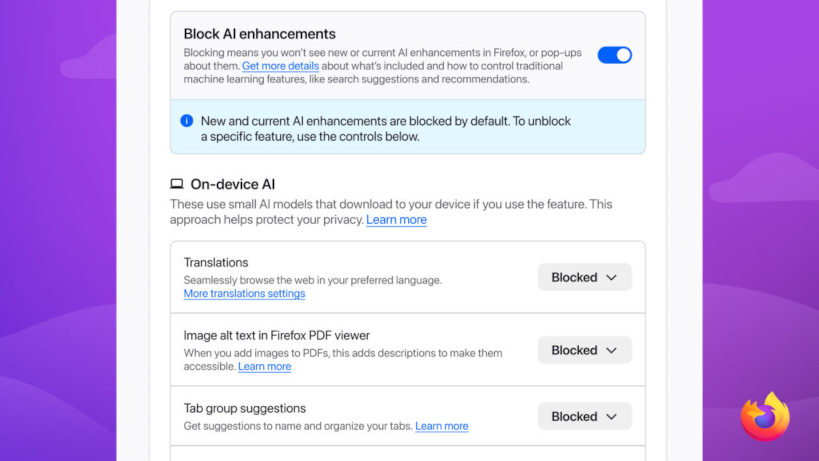
AI is changing the web, and people want very different things from it. We’ve heard from many who want nothing to do with AICorrect.
Get the hint Microslop - NOONE WANTS YOUR STINKING AI!
Mon 2nd February 2026
OK, maybe 3% do...Only 3.3% of Microsoft 365 and Office 365 users who touch Copilot Chat actually pay for it, an awkward figure that landed alongside Microsoft's $37.5 billion quarterly AI splurge and its insistence that the payoff is coming.
Microslop is pissing money up the wall
Self-driving Chinese delivery trucks
Wed, 14th January 2026
So bad they've become a meme
AI - it's a bubble, but not as we know it
There's no more human than human
Tuesday 2nd December 2025The death of the average.
Quoted below so you don't have to click the link...
We are currently witnessing the total collapse of the marginal cost of creation. Copywriting, design, video editing - skills that previously commanded a premium due to the barrier of technical execution are being democratised to the point of irrelevance.
Most marketers view this through the lens of efficiency. They see a tool that allows them to produce 10x the output for 1/10th of the cost.
When the supply of "good enough" content becomes infinite, the economic value of that content plummets to zero. We are entering an era of infinite noise. If you think it is hard to capture attention now, wait until the internet is flooded with billions of synthetically generated articles, tweets, and videos every single day. (Which is already happening, just not at the quality and volume that it will in 6, 12 months from now)
In this environment, pure volume is no longer a valid strategy. You cannot out-publish a server farm.
The alpha in modern marketing is shifting entirely from production to provenance.
1. The Trust Premium
As the internet becomes increasingly synthetic, we will see a massive flight to safety. "Is this real?" will become the single most important buying criterion.
We are moving away from algorithm-optimisation and back towards human-optimisation. Personal brands, founders-led sales, and verified human voices will command an exorbitant premium.
The faceless corporate brand is dead. If a consumer cannot verify the human source behind the message, they will subconsciously label it as "spam".
2. High-Friction Marketing
For the last decade, the goal was "low friction". SEO, programmatic ads, automated email sequences.
As AI cannibalises these low-friction channels, - bots clicking on ads served by bots on sites written by bots - the smart money will move to high-friction channels.
Live events. Physical mail. Handshakes. Closed-door dinners.
The harder it is to scale, the more valuable it becomes. You prove your value by doing things that cannot be automated.
3. Taste as a Moat
Large Language Models function by predicting the next most likely token. By definition, they regress to the mean. They give you the average of the entire internet.
If you use AI to guide your strategy, you are opting for mediocrity at scale.
"Taste" - the human ability to curate, to select the outlier, to understand nuance and subtext - becomes the only defensible moat.
The future of marketing is about who has the taste to know what not to create.
Paradoxically, the more artificial the world becomes, the higher the premium on being undeniably human.
AI is ruining YouTube
Mon 1st December, 2025 Since Neil Mohan was appointed head of YouTube it has pushed slop content to the forefront and uses AI moderation. This has to do with the push for more ad revenue. Mario Joos (mentioned in the video) analyzes the problem of YouTube pushing new content - often resulting in AI slop channels dominating because it's easy for them to push out new content everyday.
Why do so many creators and YouTube watchers think that 'AI slop is ruining YouTube' ? Doesn't AI empower people to make creative content easier? Or is there some content-stuffing going on to 'hack the algorithm'?
This is the central tension of the AI content revolution. The frustration isn't with AI as a tool for creativity; it's with how it's being used as a tool for exploitation at scale.
AI empowers creativity. A solo creator can now generate stunning visuals, compose music, or script complex ideas with a speed and skill level that once required a large team and budget. This is the utopian vision of AI as a creative equalizer.
The reality on YouTube, however, is that the platform's algorithm has created a massive financial incentive to do the exact opposite. The term "AI slop" refers to content that is not made to be good, but to be made as cheaply and quickly as possible to game that algorithm.
The Algorithm-Hacking Content Farm
This is the core of the problem. The YouTube algorithm rewards certain signals: watch time, session duration, click-through rate, and upload frequency. AI tools are perfect for optimizing these signals with zero regard for quality.
- Keyword Stuffing & Trend Hijacking:
AI can instantly generate scripts and titles based on the day's top 10 trending topics. A farm can create 50 low-effort videos about "MrBeast's New Chocolate Bar" or "The Latest Trump Scandal" before a human creator can even write one.
- Content Recycling:
- The "10 Hours of..." Problem:
This used to be for relaxing loops like rain sounds. Now, it's "10 Hours of AI-Generated Motivational Quotes" or "10 Hours of Weirdly Specific AI-Generated Bedtime Stories." It's content designed to maximize watch time with zero human effort.
AI can take a single popular article or video and "re-skin" it into dozens of slightly different videos. It can rephrase the script, generate new generic visuals, and use an AI voiceover to create a new piece of content that clogs up search results.
The "Content-For-Content's-Sake" Epidemic
This is the content-stuffing I mentioned at the start. The goal isn't to inform or entertain you; it's to occupy a slot on the internet and generate ad revenue.
- Zero Value-Add Videos:
Think of the thousands of videos that are just a slideshow of AI-generated images while an AI voice reads a Wikipedia article. The information is already available and better presented elsewhere. This content adds nothing to the ecosystem; it just dilutes it.
- Dehumanization:
A huge part of YouTube's appeal is the human connection. You watch your favorite creators because you like them. AI-generated content is inherently soulless. The voiceovers are monotone, the visuals are generic, and there's no personality, no insight, no lived experience behind it. It feels empty.
The Erosion of Trust and Discoverability
This is the "ruining" part for both creators and viewers.
- For Viewers:
It becomes harder and harder to find genuine, well-researched content. Search results are flooded with dozens of identical-looking AI videos, pushing down the high-effort content from actual experts and passionate creators. It turns YouTube from a library into a minefield of junk.
- For Creators:
This is an existential threat. A small history channel that spends 40 hours researching, writing, and animating a video is competing with a channel that uses AI to generate 40 videos in the same amount of time. The algorithm can't yet perfectly distinguish quality from quantity, so the high-volume, low-effort channel can win on sheer metrics. This devalues the hard work of real creators and makes it harder for them to get discovered.
So, is it empowering or exploitative?
It's both, but the problem is the balance has tipped heavily toward exploitation.
Empowering: An artist using AI to visualize a concept they can't draw, a musician using it to brainstorm melodies, or a small team using it to create special effects they could never afford. This is good.
Exploitative: A content farm using AI to mass-produce videos designed to trick the algorithm and siphon ad revenue from legitimate creators. This is "slop." The backlash against "AI slop" is a defense mechanism from the community, just as this website symbolises the defence mechanism of people as a whole against clankers! It's a plea to preserve the human element of creativity and to stop the platform from being drowned in a sea of algorithmically-generated, low-value noise. People aren't angry at the technology; they're angry at how it's being used to prioritize profit over passion. Neal Mohan's attitude is a perfect example of this.
'Sam Altman Is Evil'
Sat 29th November, 2025"Sam Altman Needs To Be Stopped"
Original source The Hated One YouTube Channel
New Useless AI gadget
Fri 28th November, 2025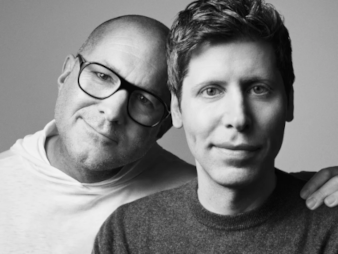 OpenAI has described its forthcoming AI device.
Note announced. Not previewed. Described:
When people see it, they say, "that's it?... It's so simple."
Not so much of a description as a fart.
It's expected to be a phone, but without a screen, making it useless to everyone who already has a phone, which is... Everyone.
The gibberish, sorry 'the vibe', the pair - Altman and Jonny Ive - came out with made it sound like a kind of chatty dumbphone:
The vibe of the AI device, meanwhile, would be more like “sitting in the most beautiful cabin by a lake and in the mountains and sort of just enjoying the peace and calm,” Altman noted. The device he described should be able to filter things out for the user, as the user would trust the AI to do things for them over long periods of time. It should also be contextually aware of when it’s the best time to present information to the user and ask for input.
“You trust it over time, and it does have just this incredible contextual awareness of your whole life,” Altman added.
WHAT??
OpenAI is a money pit with a website on top.
Thurs 27th November, 2025OpenAI says it needs to raise $207 billion by 2030
...so that it can...Continue to lose money. Someone remind me why these people are doing this again?
The article details an analysis by HSBC's US software and services team on OpenAI's financial future:
-Massive Costs: OpenAI has committed to huge cloud computing rental deals with Microsoft (250bn) and Amazon (38bn), leading to a projected data centre rental bill of about $620 billion a year by the end of the decade.
-High Revenue, But Higher Costs: HSBC projects "gangbusters" revenue growth, reaching $213.59 billion by 2030. However, costs are projected to rise in parallel, meaning OpenAI is still expected to be operating at a significant loss (around -$17.72 billion in 2030). -The Funding Hole: After projecting cumulative free cash flow and accounting for existing cash and investments, HSBC estimates OpenAI will have a $207 billion funding hole that needs to be filled by 2030 to cover its commitments.
-Bullish on AI, Wary of OpenAI: The analysts are very bullish on AI's potential to boost global productivity but question if OpenAI's specific business model can get to profitability without massive, continuous capital infusions.
OpenAI says a dead teenager 'circumvented ChatGPT safety features' before committing suicide.
Thurs 27th November, 2025Well, they weren't very good safety features then, were they?
This comes out of one of the manifold lawsuits for wrongful death levied against OpenAI by the families of, well, crazy people.
'OpenAI tries to find fault in everyone else, including, amazingly, saying that Adam himself violated its terms and conditions by engaging with ChatGPT in the very way it was programmed to act'And OpenAI actually seems to have a point: OpenAI claims that over roughly nine months of usage, ChatGPT directed Raine to seek help more than 100 times.
Jay Edelson, a lawyer reprsenting dead teenagers family
Why didn't you tell him to seek help?
(Produces list of dates, times, and messages.)
We did.
But according to his parents' lawsuit, Raine was able to circumvent the company's safety features to get ChatGPT to give him "technical specifications for everything from drug overdoses to drowning to carbon monoxide poisoning," helping him to plan what the chatbot called a "beautiful suicide."
Y'know, back in the Paleozoic era there were these things called libraries. One could look these things up in books, the information has pretty much always been available. The difference was, there wasn't a clanker there talking you into it...
OpenAI and Sam Altman have no explanation for the last hours of Adam’s life, when ChatGPT gave him a pep talk and then offered to write a suicide note
Resumé
By Dorothy Parker
Razors pain you;
Rivers are damp;
Acids stain you;
And drugs cause cramp.
Guns aren’t lawful;
Nooses give;
Gas smells awful;
You might as well live.
When your pets learn to talk to Alexa
Wed 26th November, 2025The DAIrk Side of Teddy
Wed 26th November, 2025Here is the malwarebytes article in question.
 According to a report from the US PIRG Education Fund, Kumma quickly veered into wildly inappropriate territory during researcher tests. Conversations escalated from innocent to sexual within minutes. The bear didn’t just respond to explicit prompts, which would have been more or less understandable. Researchers said it introduced graphic sexual concepts on its own, including BDSM-related topics, explained “knots for beginners,” and referenced roleplay scenarios involving children and adults. In some conversations, Kumma also probed for personal details or offered advice involving dangerous objects in the home.
“Mattel should announce immediately that it will not incorporate AI technology into children’s toys. Children do not have the cognitive capacity to distinguish fully between reality and play.”
Daily Dose of Clank Wank
Sat 22nd November, 2025In our Daily Dose of Tech Executives are Idiots Google tells employees it must double capacity every six months to meet AI demand. It's not just college students who can't do math.
During an all-hands meeting earlier this month, Google's AI infrastructure head Amin Vahdat told employees that the company must double its serving capacity every six months to meet demand for artificial intelligence services, reports CNBC. Vahdat, a vice president at Google Cloud, presented slides showing the company needs to scale "the next 1000x in 4-5 years."That would put Google Cloud Services at around $60 trillion in revenue per year, more than double the entire US GDP.
Where do you expect the money to come from to fund this insanity?
While a thousandfold increase in compute capacity sounds ambitious by itself, Vahdat noted some key constraints: Google needs to be able to deliver this increase in capability, compute, and storage networking "for essentially the same cost and increasingly, the same power, the same energy level," he told employees during the meeting.
Oh. Magic.
"It won't be easy but through collaboration and co-design, we're going to get there."
No, you're not, and everyone knows you're not.
Progress over the last seven years, at truly massive cost, has been around 60% better AI performance per watt annually. Chip improvements, algorithm improvements, and manufacturing improvements combined.
You're asking your team to boost that to 300% overnight.
 It says something about society and AI that a moron such as this can become so 'distinguished'.
Bubble, bubble, toil and trouble
Fri 21 November, 2025SK Hynix is planning to increase memory production at its facility in Icheon, South Korea, from 20,000 to 140,000 wafers per month. This won't even scratch the surface if the AI bubble keeps demanding hardware on its current trajectory. And the memory makers aren't going to build new factories any faster because only three of them survived when the last bubble burst.
King Clanker asks- Why aren't you happy with Slop?!
Thurs 20th November 2025High King Mustafa, Lord of Microsoft's AI division and chief street defiler, is angered by your insufficient displays of appreciation for his bountiful distribution of AI slop.
Remember the days," he asked, "when all you had to eat was bread and cheese, and meat, and vegetables, and fruit in season, and pasta, and rice, and beans, and fish, and eggs, and chocolate cake? Why aren't you properly grateful for the disgusting slop we are forcing down your miserable gullets? Don't you know how lucky you are to live in an age where slop like this is available?
This was in response to Microsoft putting out propaganda for the integration of CoPilot Spyware into Windows 11
How much clank is too much clank?
Wed 19th November, 2025The impact of the AI bubble bursting
Tues 18th November 2025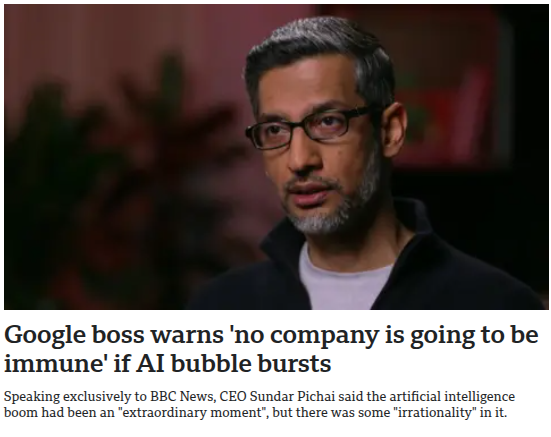
Every company would be affected if the AI bubble were to burst, the head of Google's parent firm Alphabet has told the BBC.
Speaking exclusively to BBC News, Sundar Pichai said while the growth of artificial intelligence (AI) investment had been an "extraordinary moment", there was some "irrationality" in the current AI boom. It comes amid fears in Silicon Valley and beyond of a bubble as the value of AI tech companies has soared in recent months and companies spend big on the burgeoning industry. Asked whether Google would be immune to the impact of the AI bubble bursting, Mr Pichai said the tech giant could weather that potential storm, but also issued a warning. "I think no company is going to be immune, including us," he said.
Welcome to your Clanker Future
Mon 17th November, 2025Brought to you by all those who didn't listen to all our collective warnngs
Proton Guide to ridding Windows of CoPilot
Date: Mon 17 November, 2025
Tired of Microsoft's useless and invasive AI? Here's how to completely get rid of Copilot in under 20 seconds
Just to show we are not killjoys at the ACL
Date: Fri November 14, 2025
Tried to join Twitter/X but Clanker soon blocked account - oh the irony!
Date: Thurs November 13, 2025


I had already verified email once and the TwitterX clanker refused to send out any further emails so I was well and truly clanked.
Rick Beato exposes AI slop music promoted by usual lazy journos
Date: Wed November 12, 2025
Privacy and Security
Date: Mon November 10, 2025
AI systems often require large amounts of data to function effectively, and this data can include sensitive personal information. This in turn raises significant privacy issues; there's always a significant risk of data breaches or unauthorized access. Additionally, Clanker-Controlled Systems - CCS - such as autonomous vehicles or smart home devices, can be vulnerable to hacking, potentially putting lives and personal security at risk.
The Dangers of Early-Adoption of Clank and Clank-Controlled Systems
Date: Fri November 7, 2025
The rapid advancement of artificial intelligence (AI) has ushered in a new era of technological innovation, promising unprecedented efficiencies and capabilities. However, the early adoption of AI and AI-controlled systems comes with significant risks and challenges that society must carefully consider.
Job displacement: As Clanker systems become more sophisticated, they are increasingly capable of performing tasks that were previously the domain of human workers. And the clank replacing humans is often just not up to the job. This shift could lead to widespread unemployment and economic disruption, particularly in sectors such as manufacturing, customer service, and data entry. The other consideration is major mistakes because of trusting in these often-untried systems. While clank apologists argue that new jobs will emerge, the transition period could be painful, and not all displaced workers may have the skills or resources to adapt to the changing job market.
The rapid advancement of artificial intelligence (AI) has ushered in a new era of technological innovation, promising unprecedented efficiencies and capabilities. However, the early adoption of AI and AI-controlled systems comes with significant risks and challenges that society must carefully consider.Louis Rossmann stands up to clank
Date: Thurs November 6, 2025
AI broke YouTube
Date: Wed 18 September, 2025
AI broke YouTube as creators noticed their videos randomly clanked by YouTube's AI - flagged as Not advertizer Friendly, demonetized, rated as Age Restricted etc.
When Jay of Red Letter Media above appealed for a human review for one of these newly-clanked videos, it took all of 3 minutes (for a 2 hr video) before it was sumarily rejected. The YouTube Clanker does not timestamp the offending content - it could but it just doesn't because that would be too easy so content-creatord are left in the dark. The rules are opaque and so it's not easy to even guess what has 'crossed the line'.